Dr. Carol J. Scott's framework for personal health
The SCOTT Protocol
Five habits that keep aircraft carriers, nuclear plants and airliners out of trouble, rebuilt by emergency physician Dr. Carol J. Scott for the one system nobody else can run for you: your own health.
Safety science, pointed at one person
A few organizations do dangerous, complicated work for decades without a catastrophe. The Agency for Healthcare Research and Quality describes these high reliability organizations as operating "in complex, high-hazard domains for extended periods without serious accidents or catastrophic failures." Researchers at Berkeley began studying them in 1984, on Navy aircraft carriers, in air traffic control and at a utility that ran a nuclear plant (Berkeley CCRM). What set those crews apart was a handful of shared habits of attention, practiced every shift.
Karl Weick and Kathleen Sutcliffe later distilled the habits into five principles in their book Managing the Unexpected: preoccupation with failure, reluctance to simplify, sensitivity to operations, deference to expertise and commitment to resilience. Hospitals have spent the past two decades trying to work this way. One of the best-known results, a 19-item surgical safety checklist, cut deaths after surgery from 1.5% to 0.8% when eight hospitals first tested it.
All of that was designed for organizations. Dr. Scott, a board-certified emergency physician, saw that one person's health shares the features that make those operations hazardous: many interacting parts, and failures that build quietly for years before anyone sees them. In her original description of the protocol, she wrote that "the human body has thousands of potential points of failure."
Researchers have started to notice the same gap from the other side. A 2026 study of cancer care teams found that patients and family caregivers "were primarily responsible for monitoring their health," and that commitment to resilience "relied on individual actions rather than system-level processes and structures." The authors called for future work at the level of the individual as well as the team. That is the level the SCOTT Protocol works at.
Why these five letters
Each letter carries one of the principles. Consistent monitoring carries two, sensitivity to operations and reluctance to simplify, because for a patient they amount to a single act: noticing what your body is doing now and refusing to explain it away. The fifth letter is a goal rather than one of Weick and Sutcliffe's principles. Dr. Scott's slides call it "achieving zero preventable events," the zero-harm aim that health care's high reliability leaders have taken up. And yes, the letters spell her name, which makes them hard to forget.
What it is not
It isn't a diet, a supplement plan or a way to diagnose yourself. Most of the steps end with a clinician, and the third is entirely about getting the right expert on the problem. What the protocol changes is your share of the work: what you notice, what you write down, what you ask, and how quickly you act on it.
One habit, two settings
Every step started as something crews do on a flight deck, in a control room or in an operating room. Flip a step to see the same habit at your kitchen table, then follow it to the step's own page.
-
Launch decisions at NASA, 1986
Engineers had found erosion on the booster joint seals of earlier shuttle flights. The flights came home, and over time the problem was "finally treated ... as an acceptable flight risk." Challenger broke apart 73 seconds after liftoff. Richard Feynman's verdict: "Erosion was a clue that something was wrong."
A high reliability crew reads every close call as a symptom of something larger, and never as proof that the system is safe.
In your life
Your close calls look smaller: the dizzy spell that passed, the reading that was "a little high," the relative whose heart attack came early. Self-awareness means knowing where your body is most likely to fail, and treating each small warning as information.
"A 'clean bill of health' can create a false sense of security."Dr. Scott, from the original SCOTT Protocol
-
Consistent monitoring
Adapts sensitivity to operations and reluctance to simplify
Read step 2: Consistent monitoringThe control room at Three Mile Island, 1979
A relief valve stuck open and cooling water poured out as steam, but instruments in the control room "indicated to the plant staff that the valve was closed." The staff also took a healthy water level in one tank to mean the reactor core was covered. It wasn't, and the core partly melted.
Sensitivity to operations means knowing what is really happening right now. Reluctance to simplify means refusing the comfortable explanation.
In your life
A normal reading at your yearly checkup is one indicator light. A home log shows what your blood pressure does the rest of the year, and a dated symptom note shows what your body does between visits.
"My headache, thirst and blurred vision are just due to working hard and lack of sleep. In actuality these are symptoms classic of diabetes."Dr. Scott's example of oversimplifying, from the original SCOTT Protocol
-
A runway in fog at Tenerife, 1977
Moments before the KLM 747 struck a Pan Am 747 on the runway, its flight engineer asked, "Is he not clear, then?" The captain answered yes. Thirteen seconds later the two jets collided, and 583 people died in the deadliest accident in aviation history.
Deference to expertise sends a decision to whoever knows the most about the problem, not whoever has the most seniority.
In your life
In your care, the expertise is split. Your clinicians know medicine; you know your own body, history and goals. Oversight means getting the right specialist on the problem, and making sure every one of them hears what you know.
"No physician is an expert in what it's like to be you or how you define wellbeing."Dr. Scott, from the original SCOTT Protocol
-
A DC-8 circling Portland, 1978
United 173 held for about an hour while the crew worked a landing gear problem, and ran out of fuel. Investigators cited the captain's "preoccupation with a landing gear malfunction" and the failure of the other two crew members "to successfully communicate their concern to the captain."
Commitment to resilience assumes things will go wrong and builds ways to catch them early: rapid assessment, and people cross-checking each other's work. Months later, a NASA/industry workshop set aviation on the road to crew resource management.
In your life
You will miss doses, skip weeks and get bad news. Tenacity is planning for the bad month before it arrives, so a setback doesn't turn into a bad outcome: a medication list someone else can find, a person who knows your history, a way back onto the plan.
"Resilience gives you the ability to acknowledge and act on a potential health risk or threat, instead of ignoring it."Dr. Scott, from the original SCOTT Protocol
-
Operating rooms in eight cities, 2007 to 2008
Surgical teams in eight hospitals introduced a 19-item checklist, run at three pauses: before anesthesia, before the incision and before the patient leaves the room. Deaths after surgery fell from 1.5% to 0.8%, and complications from 11.0% to 7.0%.
The aim behind work like this is zero preventable harm, the goal Mark Chassin and Jerod Loeb put at the center of their 2013 roadmap to high-reliability health care.
In your life
Knowing is not the same as doing. The screening you meant to book, the call about a symptom that keeps coming back, the talk with your mother about her history: taking action closes that gap, one item at a time, starting today.
"A healthy past doesn't ensure a system free from failure."Dr. Scott, from the original SCOTT Protocol
The original deck
Dr. Scott first set the protocol out on five slides, one per letter. Each pairs what high reliability organizations do with what it means for your health, and each carries a vertical S-C-O-T-T with the current letter circled, the device the step pages on this site still use.
Reproduced as she made them. The transcriptions under each slide correct two typing errors; part of one sentence on the Oversight slide is covered in the copy that survives.
Slide 1 of 5
-
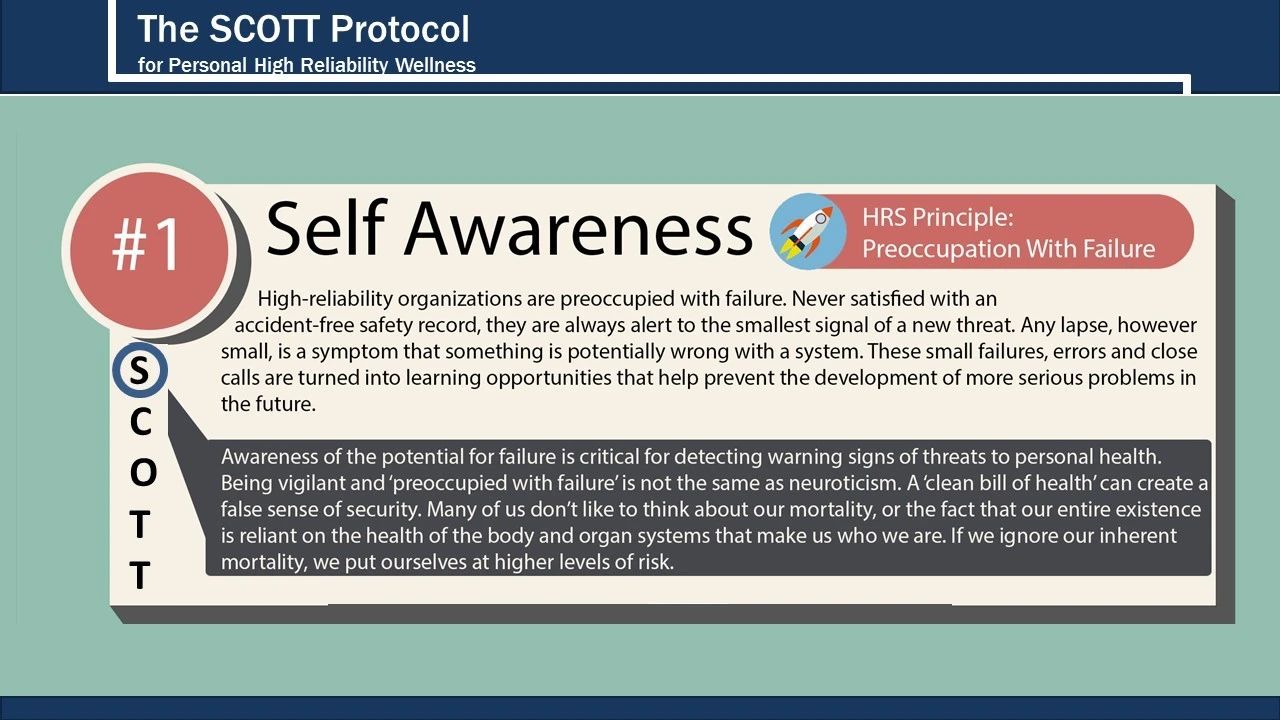
Slide 1: Self Awareness Principle on the slide: Preoccupation With Failure Read the slide's text
What high reliability organizations do. High-reliability organizations are preoccupied with failure. Never satisfied with an accident-free safety record, they are always alert to the smallest signal of a new threat. Any lapse, however small, is a symptom that something is potentially wrong with a system. These small failures, errors and close calls are turned into learning opportunities that help prevent the development of more serious problems in the future.
What it means for you. Awareness of the potential for failure is critical for detecting warning signs of threats to personal health. Being vigilant and ‘preoccupied with failure’ is not the same as neuroticism. A ‘clean bill of health’ can create a false sense of security. Many of us don’t like to think about our mortality, or the fact that our entire existence is reliant on the health of the body and organ systems that make us who we are. If we ignore our inherent mortality, we put ourselves at higher levels of risk.
-
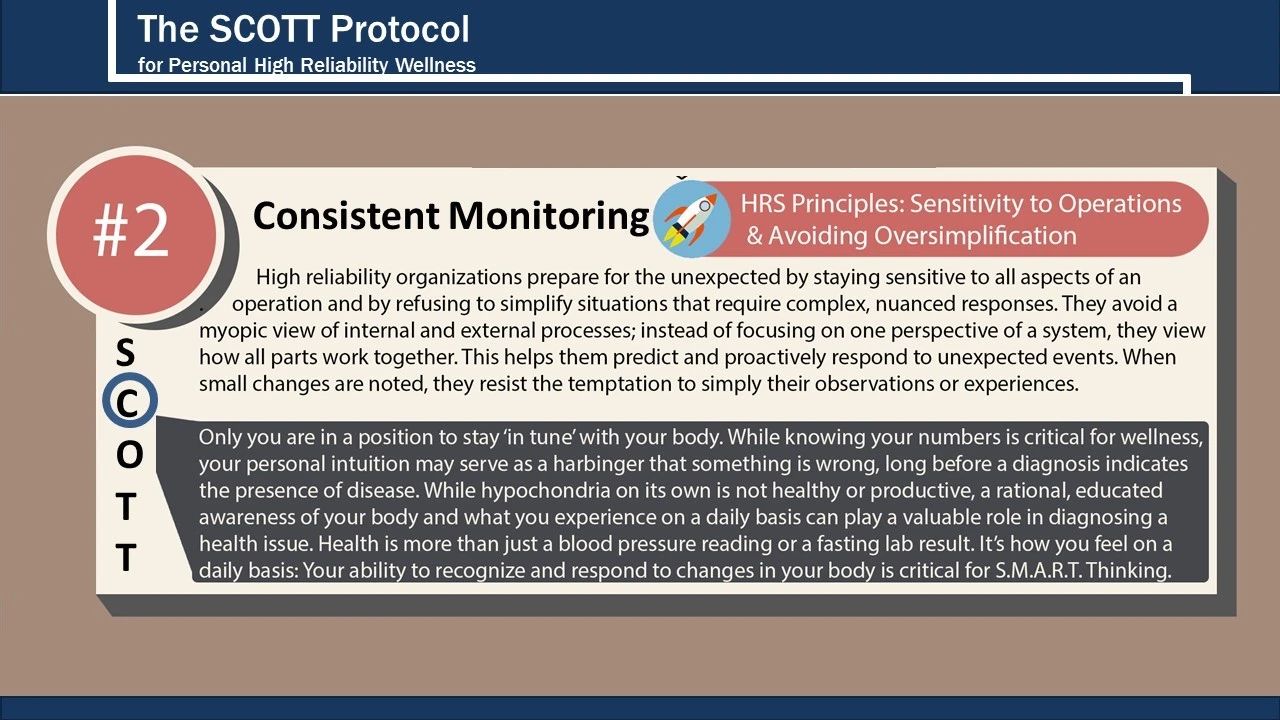
Slide 2: Consistent Monitoring Principle on the slide: Sensitivity to Operations & Avoiding Oversimplification Read the slide's text
What high reliability organizations do. High reliability organizations prepare for the unexpected by staying sensitive to all aspects of an operation and by refusing to simplify situations that require complex, nuanced responses. They avoid a myopic view of internal and external processes; instead of focusing on one perspective of a system, they view how all parts work together. This helps them predict and proactively respond to unexpected events. When small changes are noted, they resist the temptation to simplify their observations or experiences.
What it means for you. Only you are in a position to stay ‘in tune’ with your body. While knowing your numbers is critical for wellness, your personal intuition may serve as a harbinger that something is wrong, long before a diagnosis indicates the presence of disease. While hypochondria on its own is not healthy or productive, a rational, educated awareness of your body and what you experience on a daily basis can play a valuable role in diagnosing a health issue. Health is more than just a blood pressure reading or a fasting lab result. It’s how you feel on a daily basis: Your ability to recognize and respond to changes in your body is critical for S.M.A.R.T. Thinking.
-
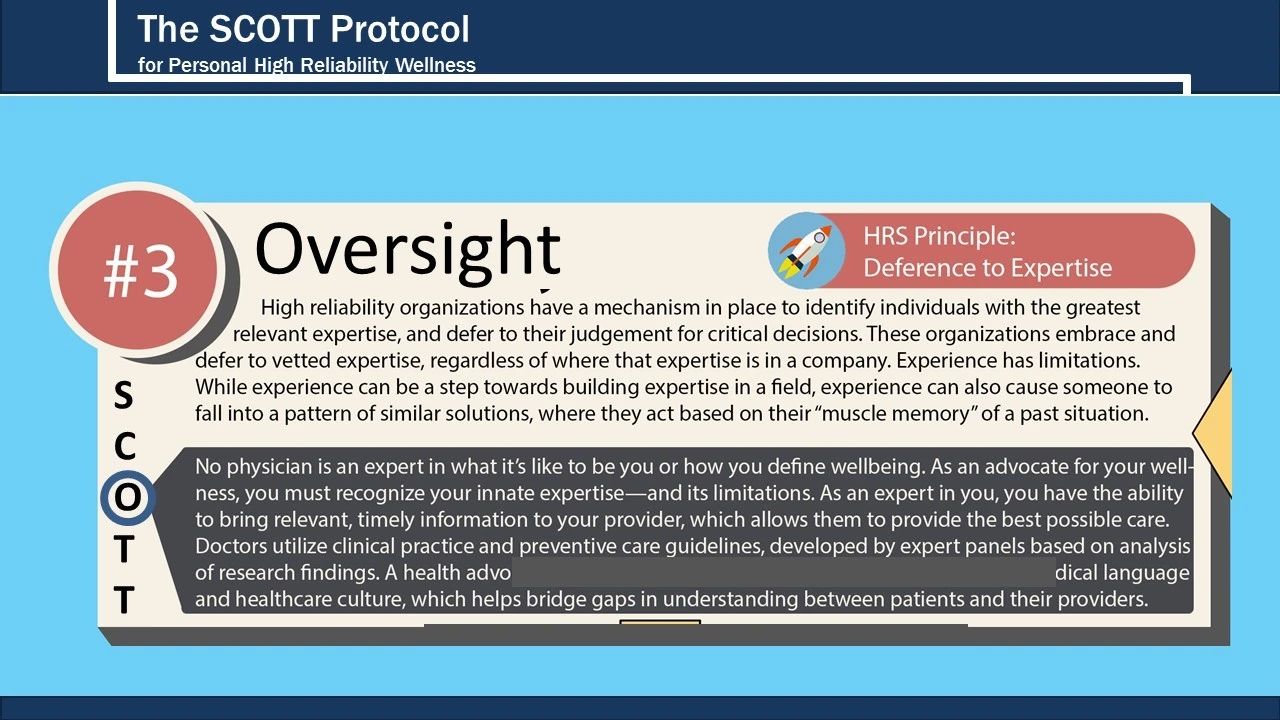
Slide 3: Oversight Principle on the slide: Deference to Expertise Read the slide's text
What high reliability organizations do. High reliability organizations have a mechanism in place to identify individuals with the greatest relevant expertise, and defer to their judgement for critical decisions. These organizations embrace and defer to vetted expertise, regardless of where that expertise is in a company. Experience has limitations. While experience can be a step towards building expertise in a field, experience can also cause someone to fall into a pattern of similar solutions, where they act based on their “muscle memory” of a past situation.
What it means for you. No physician is an expert in what it’s like to be you or how you define wellbeing. As an advocate for your wellness, you must recognize your innate expertise—and its limitations. As an expert in you, you have the ability to bring relevant, timely information to your provider, which allows them to provide the best possible care. Doctors utilize clinical practice and preventive care guidelines, developed by expert panels based on analysis of research findings. A health advo[…] [part of this sentence is covered on the surviving copy of the slide] […]dical language and healthcare culture, which helps bridge gaps in understanding between patients and their providers.
-
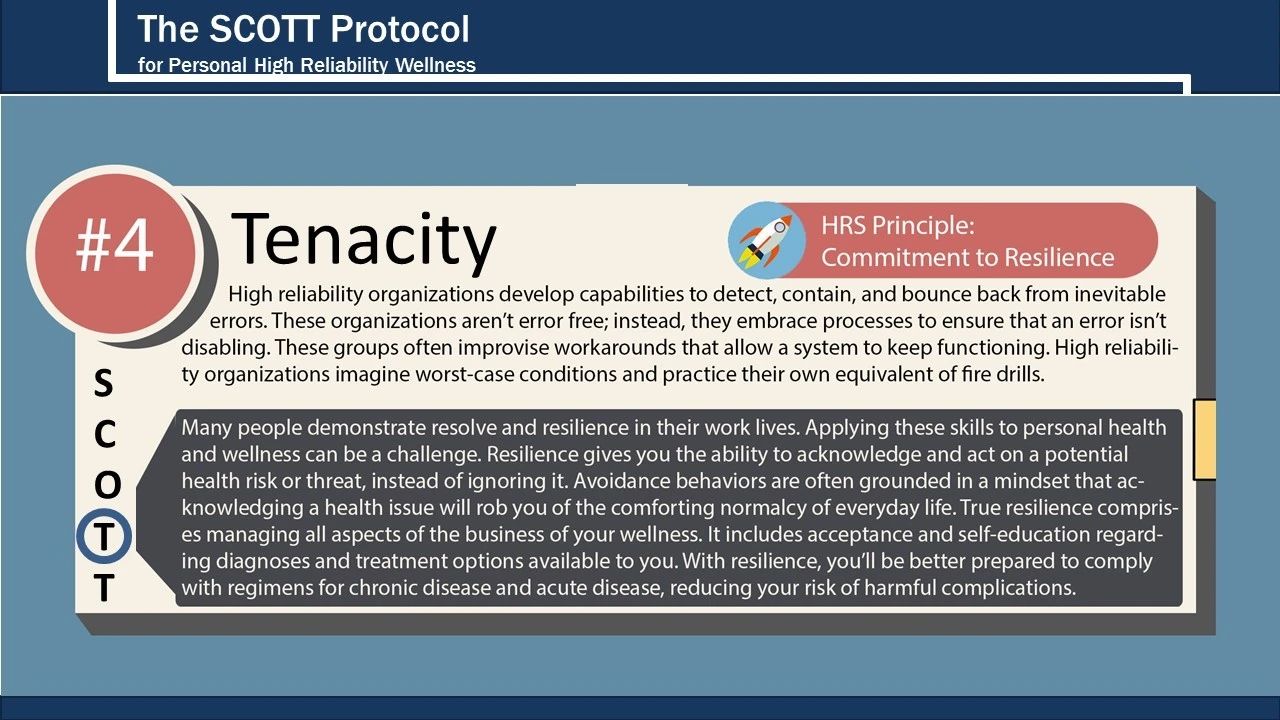
Slide 4: Tenacity Principle on the slide: Commitment to Resilience Read the slide's text
What high reliability organizations do. High reliability organizations develop capabilities to detect, contain, and bounce back from inevitable errors. These organizations aren’t error free; instead, they embrace processes to ensure that an error isn’t disabling. These groups often improvise workarounds that allow a system to keep functioning. High reliability organizations imagine worst-case conditions and practice their own equivalent of fire drills.
What it means for you. Many people demonstrate resolve and resilience in their work lives. Applying these skills to personal health and wellness can be a challenge. Resilience gives you the ability to acknowledge and act on a potential health risk or threat, instead of ignoring it. Avoidance behaviors are often grounded in a mindset that acknowledging a health issue will rob you of the comforting normalcy of everyday life. True resilience comprises managing all aspects of the business of your wellness. It includes acceptance and self-education regarding diagnoses and treatment options available to you. With resilience, you’ll be better prepared to comply with regimens for chronic disease and acute disease, reducing your risk of harmful complications.
-
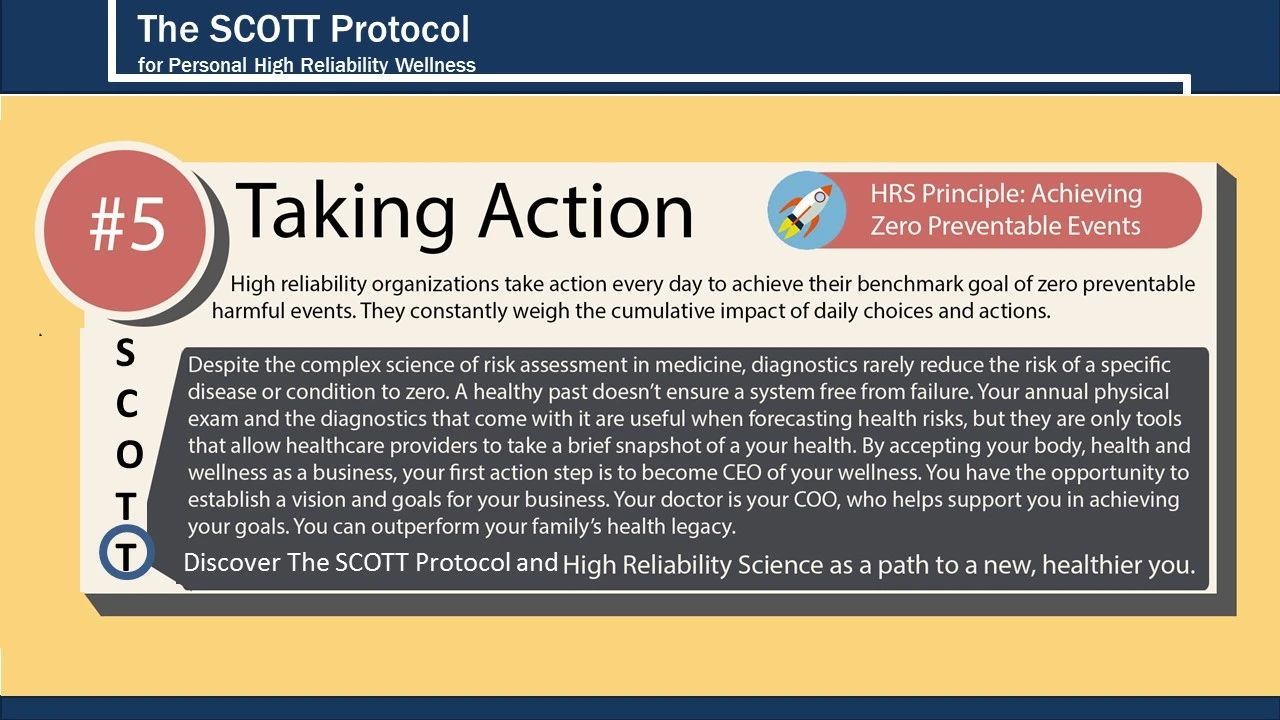
Slide 5: Taking Action Principle on the slide: Achieving Zero Preventable Events Read the slide's text
What high reliability organizations do. High reliability organizations take action every day to achieve their benchmark goal of zero preventable harmful events. They constantly weigh the cumulative impact of daily choices and actions.
What it means for you. Despite the complex science of risk assessment in medicine, diagnostics rarely reduce the risk of a specific disease or condition to zero. A healthy past doesn’t ensure a system free from failure. Your annual physical exam and the diagnostics that come with it are useful when forecasting health risks, but they are only tools that allow healthcare providers to take a brief snapshot of your health. By accepting your body, health and wellness as a business, your first action step is to become CEO of your wellness. You have the opportunity to establish a vision and goals for your business. Your doctor is your COO, who helps support you in achieving your goals. You can outperform your family’s health legacy. Discover The SCOTT Protocol and High Reliability Science as a path to a new, healthier you.
How to use the protocol
The first time through, take the steps in order; each one makes the next easier. After that the protocol works as a cycle. Run all five once a year on a date you won't forget (a birthday works), and go back to a single step whenever life hands you a reason.
Last updated October 16, 2026. Guidance cited on this site was current on that date; check with your own clinician. See our editorial policy.
The yearly review
- Update your failure points. Add new diagnoses in the family, with the age at which each was found, and anything from the past year that felt like a close call.
- Lay the year's numbers side by side. Blood pressure log, weight, lab results. Look for the direction of travel, not the last value.
- Check your team. Is one clinician seeing the whole picture? Is there a specialist you were meant to see and didn't? Does everyone have your current medication list?
- Rehearse a bad day. If you landed in an emergency department tonight, could someone hand over your history in two minutes? A one-page health brief makes the answer yes.
- Book the thing. Pick the one action you've been postponing and schedule it before you close the notebook. Your screening timeline is a good place to find it.
Go back to a step sooner when
-
You, or a parent, brother or sister, gets a new diagnosis
Revisit: Self-awareness Oversight
Update your family history; the CDC notes that a relative diagnosed younger than usual can raise your own risk. Then make sure the right specialist is involved.
-
A symptom keeps coming back, or hasn't settled after a few weeks
Revisit: Self-awareness Consistent monitoring
Log it with dates and take it to a clinician. A few weeks is the point at which the National Cancer Institute says a lingering symptom should be checked.
-
A clinician says "let's keep an eye on it"
Revisit: Consistent monitoring
Ask what to watch, how often, and what number or change should make you call. Then you are the one keeping the eye on it.
-
A medication starts, stops or changes dose
Revisit: Consistent monitoring Oversight
Watch for changes in how you feel, and check that every clinician you see has the new list.
-
You've been in the hospital or the emergency department
Going home is a handoff. Confirm who is in charge of your follow-up, and what to do if things go wrong.
-
A screening or follow-up test comes due
Revisit: Taking action
Book it the day you notice, before the reminder becomes background noise.
Want a physician to run the protocol with you?
Dr. Scott works with individuals, families and leadership teams through The Scott Health Advisory: a structured review of where your health could fail, and a plan to keep it from happening.
or call 410-336-7894